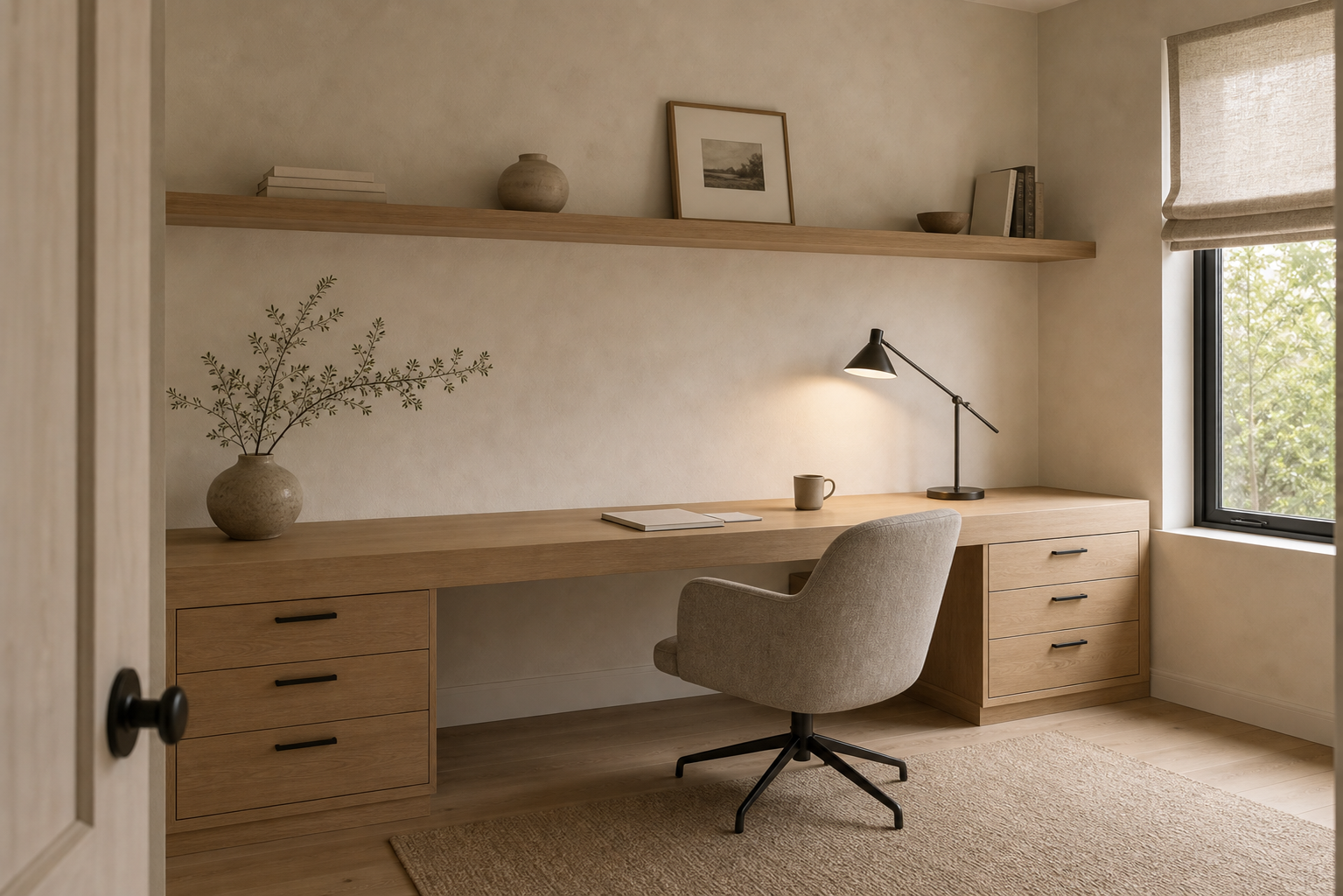

The built-in desk spans the full width of the office wall, turning a compact room into one continuous workstation. Drawer banks occupy both ends while the center remains open for the chair, giving storage and legroom equal architectural weight. A pale timber surface and matching fronts keep the broad installation warm without breaking it into several furniture pieces.
One long shelf follows the desk above at a much shallower depth, holding only a branch vessel, framed work, and a few books. The black task lamp marks the active work zone, and a side window with a woven shade supplies broad daylight. Open wall between shelf and desk protects focus and makes the built-in feel lighter than its storage capacity suggests.
The Desk Uses the Full Wall Width
The desk stretches across the wall, which gives the small office a clear working plane rather than a loose furniture arrangement. That long line makes the room feel wider and calmer. The eye follows the wood surface from one drawer bank to the other.
The desktop meets both side walls cleanly and stops beneath the window reveal, avoiding narrow leftover gaps. Its long front edge becomes the room's strongest horizontal line.
Drawer Banks Anchor Both Ends
The drawer banks at both ends give the desk practical storage without exposing office supplies. This is important in a minimalist room. The surface can stay open for notebooks, a cup and a task lamp because the everyday clutter has a place to disappear.
Each drawer bank uses broad fronts and small dark pulls, keeping the joinery rhythm wider than the books and objects above. The left bank is slightly shorter because the window occupies that end, while the right extends to the wall. Their unequal widths are absorbed by the continuous top. Internal organizers are not visible; the external design clearly concentrates closed volume away from the user's knees.
Open Knee Space Defines the Work Position
The center opening gives the chair a natural home and keeps the desk from reading as a solid cabinet wall. That void is as useful as the drawers. It creates leg room, visual lightness and a clear point where work actually happens.
The chair centers on the clear bay rather than the entire wall, aligning user, lamp, and writing area while leaving storage accessible on both sides.
One Long Shelf Establishes the Upper Datum
The shelf repeats the desk's horizontal line at a higher level, tying the wall together. Because the shelf holds only books, ceramics and framed art, it adds personality without turning the office into display storage.
The shelf is mounted high enough that the task lamp can rise beneath it without collision. Its objects gather at the left and center, leaving the right end nearly empty above the drawer bank. This asymmetry balances the large branch vessel below and prevents shelf styling from forming a repetitive line directly over the user's sightline. Blank plaster-like wall remains the dominant upper surface.
The Task Lamp Marks the Active Zone
The black task lamp creates a precise point of focus on the otherwise pale desk surface. Its angled arm adds movement and function, while the dark finish repeats the drawer pulls and chair base.
The Side Window Brings Light Across the Surface
The linen roman shade softens daylight from the right window, which keeps the office bright without feeling exposed. That filtered daylight works with the task lamp: one source gives broad daytime comfort, and the other gives focused work light.
A Soft Chair Balances the Timber Joinery
The upholstered chair brings a rounded fabric form into a room dominated by straight wood lines. Its greige tone stays close to the plaster and rug, so the chair feels comfortable without becoming a separate visual event.
The integrated approach develops the same principle seen in this Japandi home office desk wall, but uses fewer upper cabinets and a much broader area of blank wall.
A framed work leans on the shelf rather than hanging in the central wall field, keeping the area above the chair calm. The side window's dark frame and the task lamp provide enough graphic contrast; additional art over the work position would compete with the screen-free writing surface and reduce the sense of width.