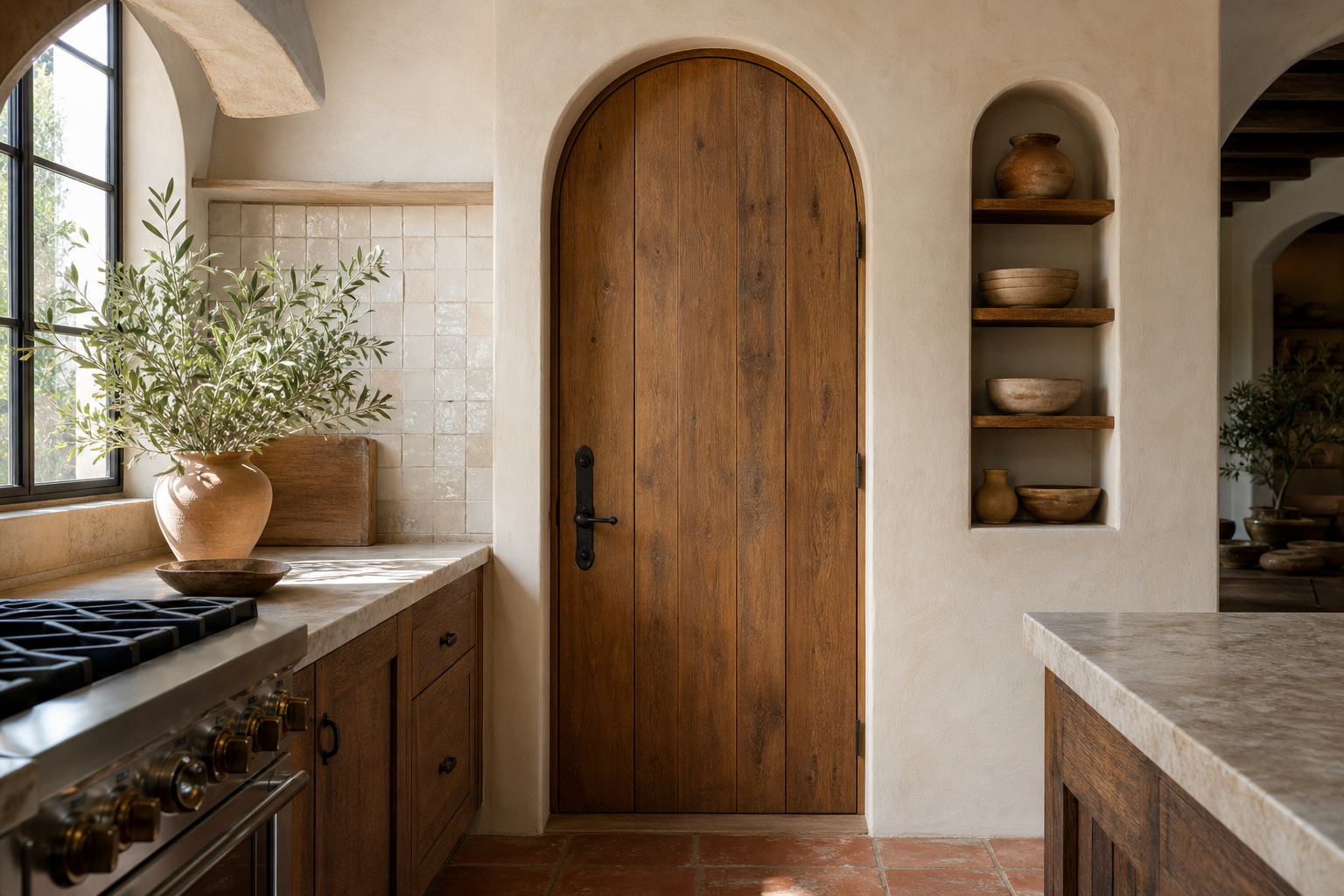

A tall rounded timber-toned door gives this kitchen wall the depth and permanence of an architectural opening. Vertical boards fill the curved frame, while one dark handle marks the working edge. A smaller arched shelf niche repeats the geometry nearby; warm lower cabinetry, pale veined counters, a dark range, and side window remain subordinate. The room succeeds because pantry access and display share one curved language at different scales.
The Rounded Door Establishes the Main Kitchen Axis
The pantry door is tall, centered and framed by a thick pale textured arch, so it immediately becomes the strongest architectural feature in the kitchen. Its vertical timber-toned boards add warmth and rhythm against the smoother pale textured, making the storage door feel permanent rather than utilitarian.
The door rises nearly to the ceiling and remains narrower than the adjacent work zone, giving it a strong vertical presence without consuming the entire elevation.
The pale textured curves around the top of the door and creates a deep reveal. That depth is what makes the arch feel built into the wall instead of applied as decoration. This is a key Mediterranean move: the wall thickness becomes part of the design.
A related Mediterranean arched-niche study focuses on display. This kitchen makes the larger arch functional as a door and keeps open objects inside the smaller recess.
A Thick Reveal Gives the Curve Visible Depth
The black dark handle and hinges stand out against the warm wood. They give the door a practical, hand-forged quality without adding unnecessary ornament. Because the hardware is limited to the door, it sharpens The primary feature rather than spreading dark accents everywhere.
Shadow around the rounded head confirms a substantial wall reveal rather than applied trim. Its pale surface separates the timber boards from the warm cabinetry below.
Dark Hardware Marks the Usable Edge
The cream tile backsplash on the left provides a smaller, glossy texture beside the matte pale textured and wood. It keeps the cooking area readable while letting the arched door remain dominant. The tile grid also contrasts with the curved doorway, which makes the arch easier to notice.
The Smaller Shelf Niche Repeats Rather Than Competes
The open niche on the right repeats the arch language at a smaller scale. Its ceramic bowls and wood shelves support the pantry door without copying its size. This repetition is measured, which is why the wall feels connected rather than themed.
Three shallow shelves hold a limited group of vessels and leave curved wall visible. Their restraint prevents the niche from becoming a second pantry frontage.
Warm Cabinetry Extends the Lower Material Band
The warm floor tile grounds the pantry wall with a warm earthy base. It connects visually to the clay vase and aged wood door. A cooler floor would make the pale textured and door feel less sun-washed. Here, the floor strengthens the Mediterranean mood.
Side Daylight Models Both Curved Openings
Start with the door shape and wall opening. A true arched reveal feels more convincing than a rectangular door with a decorative arch placed above it. Use wood, pale textured, dark and tile in restrained amounts so the pantry door remains the main architectural decision.
Using an Arch Where Storage Access Is Real
I would avoid bright paint on this pantry door. The natural wood is what gives the arch warmth and weight. I would also avoid filling the nearby niche with too many small pieces, because the door needs visual breathing room.
Draw the door swing, opening width, and reveal before styling nearby walls. Multiple arches of equal size would erase the hierarchy between access and display.
Warm floor tiles run toward the rounded door and reinforce its position at the end of the approach. Their broad modules stay quieter than the vertical boards.
A large leafy branch sits on the counter but stops outside the door reveal, softening the wall without covering the arch.
The adjacent range and counters remain rectilinear, which makes the rounded pantry opening feel intentional rather than part of an all-arch theme.
The pantry boards shift subtly in tone from one vertical strip to the next, giving the door movement inside its smooth pale reveal. A dark latch and hinge line remain small enough that the curved head, not hardware, defines the opening.
The nearby counter stops before the door frame and leaves a clear standing zone at the threshold. This visible separation prevents preparation surfaces, cabinet doors, and pantry access from competing for the same narrow piece of floor.